*This post may contain affiliate links. As an Amazon Associate we earn from qualifying purchases.
RC stands for remote (or radio) control and one of the most popular RC items are RC cars. RC cars are quite popular because the sport can be enjoyed by people of all ages and can be used in a variety of places including inside your house, in your yard, on the street, or in a local park.
These RC cars are powered by batteries or fuel and RC car/truck racing is a popular way to spend time among RC vehicle enthusiasts.
One of the questions that many hobbyists have is, how universal are RC bodies? Can any car body that fits your model be used or do you have to use the corresponding body for your RC car/truck?
In general any RC car body can be used with a different chassis as long as the car body has the proper connectors and fits your car correctly. For example you couldn’t use an RC truck’s body on a drift style RC car and vice versa. You can however use an RC truck body from a different model or brand on a different RC truck as long as the way to connect the body fits or you have an adapter that you can use to connect the two together.
Now that we know RC car bodies can work on different makes and models as long as they are the same style there are other important things that you need to know before putting an RC body on your car.
To see the most popular RC cars just click here.
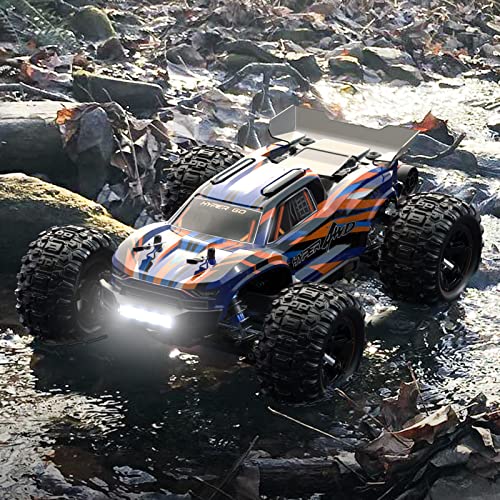
A good RC car doesn’t have to cost a fortune. This 1/16 scale model is 4WD and can reach a top speed of almost 30 MPH!
With speeds like that and 4WD you can take this RC car almost anywhere!
RC bodies
Due to usage on rough terrains, the body of your RC vehicle will likely take quite a beating. All those flips and rolls your vehicle went through, will certainly have an effect on its body. This will lead to the wear and tear of the body and can often result in pieces breaking off.
Since this is a common issue, a replacement for the car/truck’s body can normally be found in a variety of places including hobby shops and online. If your RC car is a cheaper model there might not be replacement bodies available for it.
RC bodies are available in a variety of sizes to suit the wide range of RC vehicles but how do you shop for the right body for your RC vehicle?
RC body retailers usually mention the brand name, model and the dimensions of the product the RC body is meant for. Thus, all that the user has to do is simply filter the search results by product name, dimensions and look for an appropriate body for their model.
Shopping for an RC body
RC bodies are available in many options – some are painted, some have attractive decals on them and in case you wish to unleash your creative side, there are plain RC bodies available as well which you can paint to suit your style. Some stores give their customers the option of ordering a pair of body scissors and spray paint, along with a clear body.
While all of this may seem like a simple task. It mostly is, until you are not able to find an RC body meant for your vehicle type. In that case, what do you do?
Finding the right fit
Since the fitting of the body mainly depends on the dimensions of the car, look for bodies meant for cars with dimensions similar to yours. A body for a 1/10 RC car should fit a 1/10 car of any brand as long as they are the same style of RC car or truck. There are common bodies for a group of RC brands and the dealer will most likely list all the brands that the body would fit. This will help you find a suitable body for your car.
Any store that you go to should also list the specifications of the body. A quick look into your user manual will help you in deciding whether a body of a particular specification is right for your model.
Sometimes, the body you purchased may not perfectly fit your model. At such times, a slight modification to the mounting holes might fix the issue. Sometimes, the rear needs to be trimmed or the tires of your model won’t fit and other parts of the body will have to be cut out.
Thus, you can say that RC bodies are somewhat universal, but they depend on the scale of the truck/car as well as matching the specific style of vehicle. Once the scales match, it is easy to make the body fit the vehicle, with certain modifications made as needed.
Also, RC bodies with fancy LED lights are available. These are universal and the LED lights can be mounted on any model no matter what the specifications are.
Some companies sell an RC body kit, which comes with adjustable wings, mounts, and screws. You will have to assemble the body using these adjustable parts. The kit may also have accessories such as side sport mirrors and windshield wipers.
If you are not satisfied with the RC car bodies that are available you can even make your own! Check out the video below to see exactly how that can be done.
RC vehicles – the basics
RC vehicles can be broadly categorized into toy-grade cars and hobby grade cars. What is the difference between the two?
Hobby-grade models
Hobby-grade RC models are larger than toy-grade vehicles. They are quite popular among hobbyists who love adding the latest models to their prized collections. They are sold either as RTR (ready to race) or as a kit. Previously, all models were shipped as a kit. A kit would come with parts that needed to be assembled before one could start driving.
In recent years, the RTR form was introduced. RTR stands for Ready to Race and as the name suggests, the RC car is pre-assembled, and the user can start racing right away. This was an instant hit among RC enthusiasts and now almost all the major brands ship RTR models of their RC vehicles that require minimal or no assembly. The body is also painted and trimmed as well. So, the customer does not have to spend time building the model at all and can start having fun right away.
Toy-grade models
Toy-grade RC models are smaller in size. Manufacturers do not pay much attention to the spare parts in toy-grade models and they are usually made up of inexpensive parts and it is tough to find replacements, unlike hobby-grade vehicles.
The maintenance of toy-grade models is easy and inexpensive and often just involves charging the battery. However, their performance is also not as good as that of hobby-grade RC cars and trucks. The performance can be improved by replacing certain parts with spare parts meant for hobby-grade models but this is normally not worth the time or money involved.
Toy grade RC cars are best used by children and can normally be found at retail stores such as Walmart or Target.
Accessories
The purchase of an RC car/truck is hardly the end of it. Usually, several accessories need to be bought separately. If the car is electrically powered, it is a must to have battery packs and a suitable charger. These are sometimes not included with the car so that is definitely something to pay attention to when buying.
You will also need a soldering iron to help you with attaching the upgraded spare parts if you decide to go that route. Batteries are of two types – LiPo and NiMH. LiPo batteries are more powerful but may catch fire if exposed to extreme heat. NiMH batteries are less powerful but safer. Depending on your priority and the kind of RC model you wish to buy, you can choose an appropriate battery type.
Conclusion
One can say that RC bodies are universal to some extent. You can fit bodies of a specific scale, to an RC car/truck of that scale. Although, sometimes some modifications have to be made with the rear and mounting holes to obtain a perfect fit.
An RC body can be an outlet for your creativity too. You can decorate the body with funky decals or paint them with colors of your choice. Pre-decorated bodies are also available.
Refer to your user manual and go through the specifications of the body, listed in the description. This way, you can find an appropriate body for your RC truck/car. You can also take your specs into a local hobby shop and ask the person for help in finding a body that will fit properly. Most shop owners are quite knowledgeable and should be able to point you in the right direction.