
*This post may contain affiliate links. As an Amazon Associate we earn from qualifying purchases.
If you would like to have one of the most enticing and memorable experiences on the ocean, it’s none other than having a remote control boat. In addition to an unforgettable adventure, remote control boats provide a fantastic experience that will stay in your memory for a long time to come.
You can go a long ways out in the water and just cruise your RC boat around or you can make impeccable manoeuvres using the remote controller to show off to your friends.
Remote control boats come in various designs, colors and with different performance as well. These boats come equipped with waterproof electronics and excellent remote control range for high efficiency.
When you are talking about using your RC boat on the ocean it is important to get the right one that can handle the waves while also not spending a fortune as over time the salt water will eventually damage your RC boat unless you clean it properly every single time that you take it out on the water.
That is why most of the RC boats in this article that we recommend you use on the ocean are quite inexpensive so if you do end up forgetting to clean them it isn’t the end of the world.
If you want to see what’s possible with a large and fast RC boat and if you aren’t worried about a budget then check out this monster in the video below.
To see some of the most popular RC boats currently available just click here.
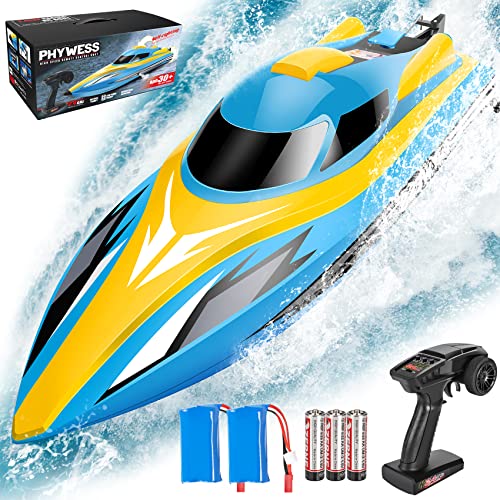
Of all of the RC vehicles that you can purchase RC boats are by far the most reasonably priced. This model can go over 20MPH, comes with the needed batteries, and remote.
All of this is included without breaking the bank!
So… without further ado:
The best RC boats for using in the ocean
Police speed RC boat
This RC boat is far from being the top of the line and honestly it is more like a toy than an expensive hobby boat however as cheap as this boat is it’s a great option to use in saltwater.
This model offers simple controls and is also programmed not to run unless it is in the water for safety reasons.
This boat’s controllers offer 40 MHz/27MHZ frequencies and when fully charged will give you 15-20 minutes of runtime (depending on how hard you run it).
Features
- Uses double engines
- Won’t start unless it’s sitting in water
- More than 100 feet of distance allowed from the remote
You can find this cheap model on Amazon by clicking here.
Yezi remote control boat
The Yezi RC boat comes with many different features extraordinary including automatic flip correction while also coming with two batteries to slow you to have fun for longer. This model is certainly more expensive than the first one but is still quite cheap so it won’t break the budget while also offering more power and features than the forts boat mentioned.
This boat utilizes a superior RC controller where it’s anything but difficult to learn and control. The controllers respond quickly where the transmitter works perfectly while giving a quick reaction as long as the boat isn’t too far away from the controller.
Features
- Has a much more powerful engine than the first model mentioned.
- Is designed with a flip recovery option which is incredibly helpful on the ocean.
- Easy to work controls
- Batteries last much longer and allow you to go much faster than other models.
This is one of the better reviewed RC boat models currently available so it’s certainly worth checking it out.You can find the price and reviews on Amazon here.
Altair AA102 RC boat
To make some incredible memories on the ocean this Altair RC boat is something that you will not want to miss. It’s a fast unit that can move at a speed of up to 20mph and it also has a CSP youngster safe propeller framework, which makes it great for the children and adults.
This model also comes with two batteries to double your total time before needing to recharge or to allow you to charge one while you are using the other!
This RC boat is also quite sturdy so it will last you much longer than other alternative options.
With low battery and out of range alarms you are much less likely to lose your boat accidentally while on the ocean as well so that’s a great bonus with this model.
Features:
- Two 1500mAh batteries
- Manufactured with a strong exterior and hull
- 390 sized brushed engine
- CSP youngster safe propeller
- Anti-Capsize system
This model is a great choice to take out on the ocean and you will have plenty of fun using it! To learn more about this model or to see the current prices on Amazon click here.
Sharkool H106 RC boat
Another great RC boat to use when you are on the ocean is the Sharkool H106. This model comes with a built in water cooled motor and top speeds of 15mph. As with the previous model this one comes with a low battery warning to help keep you from losing your boat by not realizing the battery is about to die.
This feature is especially important on the ocean since losing control of your boat on the ocean will likely mean you will never see it again.
Features:
- Double hatch design to protect the boat from water
- Has a capsize recovery mode (perfect for ocean use)
- Has an emergency stop feature that is useful if you or the person driving the boat get in trouble.
- Comes with 2 batteries
This model has quite a few reviews on Amazon with almost all of them being positive so that is a good sign as well. Check out those reviews by clicking here.
Funtech RC boat
This Funtech RC boat is another great choice for ocean use. It has a streamlined build which helps it cut through the waves while still going quite fast.
It can reach speeds of up to 18mph which is about average for this size of RC boat. It of course also comes with the option to automatically right the boat if it gets rolled over by a wave or accidental turn.
This boat is a great choice for kids and adults alike and because the price is quite reasonable you won’t have to worry too much about it getting accidentally damaged by overexcited children.
It has a run time of approximately 15 minutes but only comes with a single battery which is a downside to this model.
Features:
- Comes with a streamlined design for high performance.
- Has a maximum speed of 18mph.
- Has an anti-capsize feature
- Run time of up to 15 minutes.
This is another great model but the fact that it only has one battery is an issue for many people. You can learn more about this model on Amazon here.
Conclusion
I hope this list of the 5 best RC boats to use in the ocean has been helpful to you. Although each boat is different there are of course many similarities between them with the prices all being in the same range as well.
You find that in general many RC boats offer decent performance at a budget price. Most of the RC boats mentioned feature a racing design, excellent and robust motors that enable you to maneuver easily.
These RC boats provide excellent recreation and will help keep you from ever getting bored on your next trip to the water.